Connection and recognition
Trust, affection, enjoyment, appreciation and the ways each person feels seen.
 TERROIR TRAILSA Third Field practice

THE PRACTICE BEHIND TERROIR TRAILS
The Third Field is the experience of being together: how you connect, share everyday life, respond to differences, and make room for what matters to each of you.
It is felt in how easy it is to speak, how care reaches daily life, and whether each person has room to matter. The practice helps you notice what sustains that shared life and what this season may ask of it.
A Couples Map reads that experience in context. We do not assign personality types or score compatibility: the focus is what happens between you and what deserves attention now. How the Map differs from a personality profile.
WHAT WE NOTICE AND NURTURE
Feeling known. Care that reaches everyday life. Room to disagree and find a way back. A future that has space for both people.
Trust, affection, enjoyment, appreciation and the ways each person feels seen.
How practical work and its planning are carried, what supports each of you, and what may need to change.
How you listen, differ, pause, return to a conversation and respond to what happened.
How decisions take shape, what you want together, and how each person can speak in their own right.
Both people influence the field, within circumstances neither fully controls. Responsibility and impact may be very different. A reading must be able to name that difference.
THE METHOD BEHIND THE PRACTICE
Our proprietary method brings together research-informed questions, a structured framework for analysis and synthesis, and the judgment of a carefully selected Director.
The original couples questionnaire draws on peer-reviewed relationship research. Its sequenced questions invite careful attention beyond first impressions, with room to describe your experience, what it means to you and what you hope to make possible.
A defined analytical framework guides the Director’s reading of material each person permits. It connects context and different perspectives into interpretations and possible choices; the Director remains responsible for the reading.
Directors are hand-selected for experience, discretion and relational gravitas: the presence to hear perspectives, hold complexity and bring mature judgment.
Explore the research foundations and the scope of the method
FROM REFLECTION TO CHOICE
A difficult season can arrive before you have had time to prepare. Even a welcome change can ask more of a relationship than you expected. The practice offers a deliberate pause to understand what is changing, hear what each person needs, and make a realistic plan for moving through the transition together.
For a Couples Map, each person reflects privately. A Director considers the circumstances and experiences you each choose to share, and brings them into a reading for you to question, correct and use.
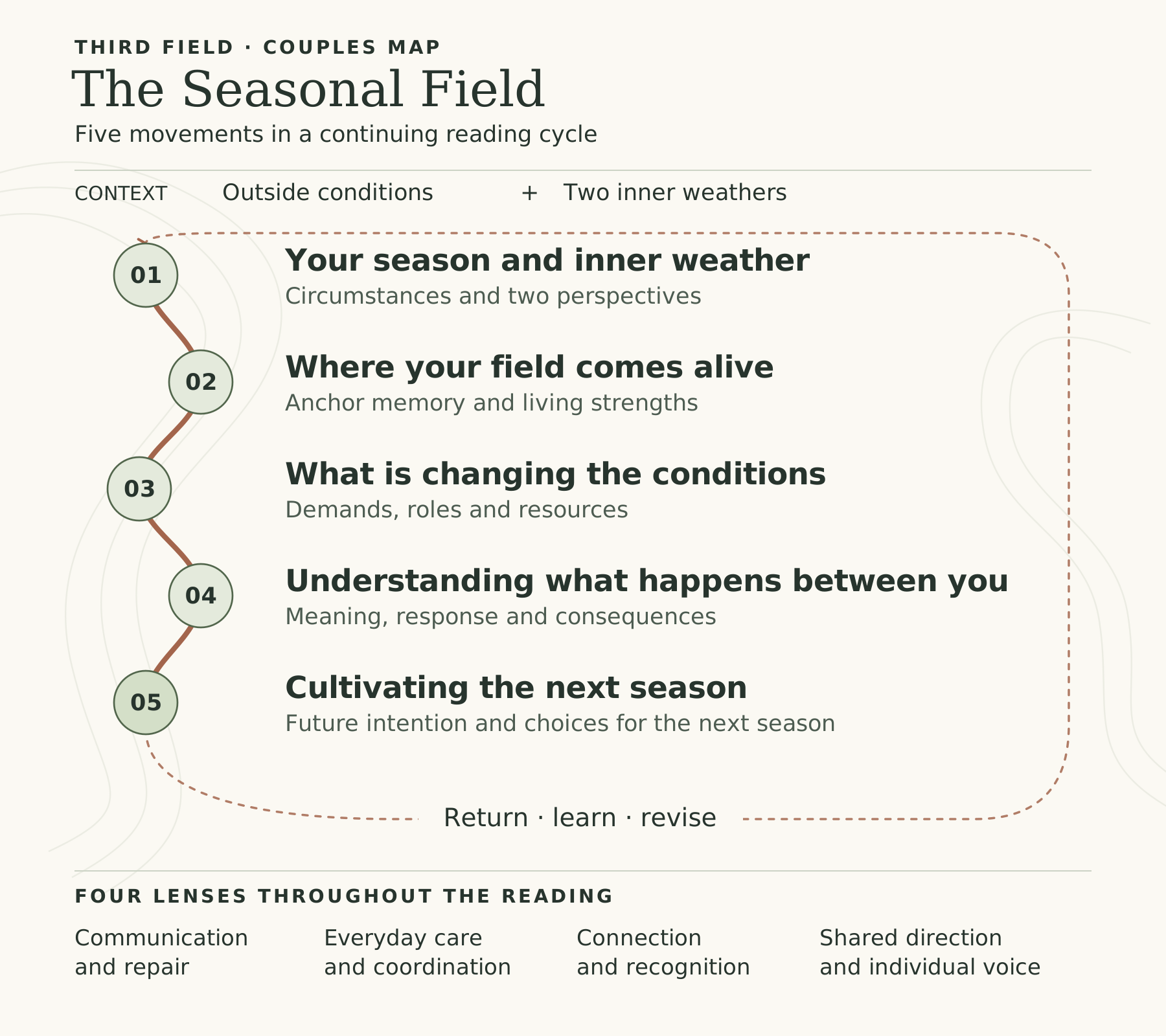
This graphic shows the reading process and its return, rather than a measured state of a relationship.
After review, you may decide to protect something already nourishing, choose a practical arrangement or a small practice, or make no new practice. A proposal is not an agreement until everyone who will carry it chooses it.
You can return to your existing Map at a date or event you choose. New reflections for a later Map bring fresh choices about where those answers may be used.
A HUMAN PRACTICE
The Map is not therapy, a validated assessment, a diagnosis or a prediction. It distinguishes each person’s approved words from the Director’s interpretation. You can question or correct the reading; meaningful changes return for review.
See how privacy and sharing choices work